What Are Nutritional Gaps in the Indian Diet?
Share
Short answer: Nutritional gaps in the Indian diet, especially low protein, iron, vitamin D, and B12, stem from staple-heavy, plant-forward eating patterns. Ashwagandha and Shilajit in Strength Essence Energy and Stamina Booster help support energy metabolism and stamina by working on the body's cellular stress and adaptogenic pathways.
What Are Nutritional Gaps in the Indian Diet?
Table of Contents
- Understanding Nutritional Gaps in the Indian Context
- What Indian Readers Are Actually Asking
- The Data: What Research Says About Indian Diets
- Ingredients That Help Fill the Gaps
- Strength Essence: Practical Use for Indian Lifestyles
- Frequently Asked Questions
Understanding Nutritional Gaps in the Indian Context
It's 7 PM on a Tuesday. You've had dal-chawal for lunch, skipped the afternoon snack, grabbed chai twice, and now you're too tired to cook anything meaningful for dinner. Sound familiar? This is not a willpower problem. It's a structural one.
The nutritional gaps in the Indian diet are not about eating too little. Most urban Indians eat enough calories. The gaps are quieter: not enough complete protein, insufficient vitamin D despite all that sunshine, near-absent B12 in vegetarian households, and iron levels that dip every monsoon when leafy greens become harder to digest.
What the top articles on this topic consistently miss is how Indian meal patterns, specifically the sequence and timing of roti-sabzi-dal-rice, interact with nutrient absorption. Phytates in whole wheat and legumes can reduce iron and zinc absorption when consumed together without a fat source. Ghee and dahi in a traditional thali actually help. The problem is that modern urban plates have dropped the ghee and dahi but kept the phytate-heavy grains.
Ayurveda flagged this centuries ago through the concept of ritucharya, seasonal eating. Winter calls for heavier, warming foods rich in fats and proteins. Summer demands cooling, lighter meals. Most urban Indians eat the same packaged or canteen food year-round, ignoring these shifts entirely.
What Indian Readers Are Actually Asking
Real questions from real people reveal the actual knowledge gap. Indian readers on health forums and platforms like Quora often ask about nutritional gaps in the Indian diet in the context of fatigue, hair fall, low stamina, and brain fog, not in the clinical language of micronutrient deficiency.
- Why am I always tired even after 8 hours of sleep? Often a B12 or iron gap, especially in vegetarians over 30.
- Is dal enough protein for a day? One bowl of cooked dal gives roughly 7-9g protein, far short of the 0.8-1g per kg body weight recommended by ICMR.
- How do I ask better health questions online? Start with symptoms + diet context. See this Quora guide for framing good health questions. More about what Quora is: learn.g2.com.
- Do supplements actually work or is it marketing? Depends on the gap. Supplements fill specific, identified deficits. They are not replacements for food.
Watch this short video on building better nutrition habits: YouTube guide on nutrition planning.
The Data: What Research Says About Indian Diets
The numbers are sobering. A 2023 analysis published in PLOS ONE (Jain et al., 1,200 Indian adults across income groups) found that over 70% of surveyed adults consumed inadequate dark leafy greens on most days. Pulse and legume intake, while present, was not enough to meet daily protein requirements without complementary sources.
A 2022 ICMR-NIN report covering 30,000 households across India found that nearly 60% of women aged 15-49 were anaemic, and vitamin D deficiency affected an estimated 70-90% of urban adults, despite India's geography. The paradox of vitamin D deficiency in a sun-rich country is explained partly by indoor office work, full-sleeve clothing norms, and high melanin levels that reduce synthesis efficiency.
Protein quality is a separate issue from protein quantity. A 2025 CEEW analysis noted that nearly 50% of Indian adults consume protein from low-bioavailability sources. Plant proteins from dal and roti are incomplete on their own, missing key amino acids like lysine and methionine unless deliberately combined.
What almost no mainstream article covers: the FSSAI vs AYUSH licensing distinction. If you buy a supplement in India labelled as an Ayurvedic medicine, it falls under AYUSH licensing and must meet drug-standard claims. A supplement sold as a nutraceutical is regulated by FSSAI under food safety rules, not drug rules. Strength Essence is a FSSAI-regulated nutraceutical supplement, not an AYUSH-licensed medicine. It supports nutrition; it does not claim to treat or diagnose anything.
Download or explore detailed nutritional data from NIN's "What India Eats" report at NIN reference resource.
Key studies referenced here: [1] [2] [3]
Ingredients That Help Fill the Gaps
Addressing nutritional gaps in the Indian diet with food alone is ideal. It's also not always realistic for a working adult in Pune or Gurgaon eating two meals outside the home daily.
This is where Ayurvedic adaptogens become practically useful. Not as miracle fixes, but as targeted nutritional support.
Ashwagandha (Withania somnifera)
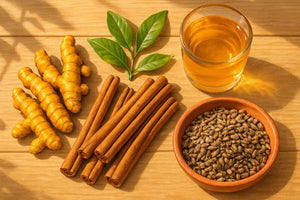
Traditionally used in Ayurveda to support vitality and resilience, Ashwagandha has been studied in modern trials for its effect on physical endurance and stress hormone balance. A 2015 randomised controlled trial (Wankhede et al., 57 male subjects, Journal of the International Society of Sports Nutrition) found that participants taking Ashwagandha root extract showed significantly better muscle recovery and cardiorespiratory endurance compared to placebo. This makes it relevant not just for gym-goers but for anyone whose energy is chronically low due to dietary gaps. [4]
Shilajit
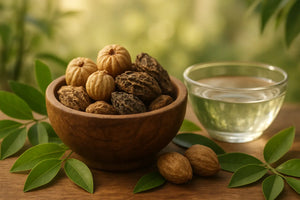
Shilajit is a resin from Himalayan rocks, rich in fulvic acid and trace minerals including iron, zinc, and magnesium — three nutrients commonly deficient in Indian diets. Traditional Ayurvedic texts describe it as a rasayana, a rejuvenative substance. A 2016 pilot study (Pandit et al., 60 healthy volunteers) found Shilajit supplementation supported mitochondrial function and reduced fatigue markers. Given that iron and B12 gaps are key contributors to tiredness in urban Indians, Shilajit's mineral-dense profile may complement dietary efforts.
Kaunch Beej (Mucuna pruriens)
Kaunch Beej is traditionally used in Ayurveda to support reproductive vitality and nervous system balance. It is a natural source of L-DOPA, a precursor to dopamine. For urban Indians dealing with chronic low motivation, brain fog, or disrupted sleep cycles, this is worth noting. Not a drug intervention. A dietary supplement that may contribute to neurotransmitter precursor availability. [5]
Supplement Forms Available in India
| Form | Availability in India | Practical Note |
|---|---|---|
| Capsule (standardised extract) | Wide, e-commerce + pharmacy | Consistent dosage, travel-friendly |
| Churna (powder) | Kirana stores, Ayurvedic shops | Traditional, but dose varies by batch |
| Kadha (decoction) | Home preparation | Seasonal use, preparation time needed |
| Ashwagandha milk (doodh) | Home preparation | Popular in winter, good bioavailability with fat |
Capsules with standardised extracts give you predictable amounts of active compounds, something churna and kadha cannot guarantee batch-to-batch.
Strength Essence: Practical Use for Indian Lifestyles
Knowing about nutritional gaps in the Indian diet is step one. Acting on it is step two. Here is how to practically use Strength Essence Energy and Stamina Booster within typical Indian meal rhythms.
With breakfast (7-9 AM): Taking it with a morning meal that includes some fat, even a teaspoon of ghee or a handful of nuts, improves absorption of fat-soluble components. Avoid taking on a completely empty stomach if you are sensitive to herbal supplements.
Post-lunch (1-2 PM): If mornings are rushed (a very real Delhi or Mumbai scenario), post-lunch works well. Digestion is strongest at midday according to Ayurvedic theory, and modern research broadly supports that nutrient absorption peaks in the mid-morning to early afternoon window.
Before bed (avoid): Ashwagandha can be calming but Kaunch Beej's L-DOPA activity may interfere with sleep for some people. Better to take Strength Essence in the first half of the day.
Your 30 / 60 / 90 Day Journey
30 days: Most users notice improved sleep quality and reduced afternoon fatigue. Energy feels more even across the day. You may not notice dramatic physical changes yet, but the baseline is shifting.
60 days: Stamina during physical activity tends to improve noticeably. People who exercise report better recovery. Those who don't exercise report feeling less drained after long work days or commutes.
90 days: The adaptogens have had time to modulate stress hormone patterns. Cognitive clarity, physical endurance, and sustained energy are the most commonly reported outcomes. This is the stage where filling nutritional gaps in the Indian diet with food plus targeted supplementation becomes a visible, felt difference.
Consistency matters more than perfection. Missing two or three days does not reset progress. But stopping at 30 days because "nothing happened yet" is a common mistake.
Frequently Asked Questions
Can I take Strength Essence alongside my thyroid or diabetes medication?
Ashwagandha may influence thyroid hormone levels, particularly T3 and T4, based on some preliminary studies. If you are on levothyroxine or any anti-thyroid medication, consult your registered doctor before starting. Similarly, Shilajit and Kaunch Beej may have mild effects on blood glucose metabolism. People on metformin or insulin should speak with a qualified Ayurvedic practitioner or physician before combining supplements with prescription drugs. Do not self-adjust medication dosages.
Does the monsoon season affect how well these supplements work?
Yes, in a practical sense. Monsoon is associated with reduced digestive fire (mandagni) in Ayurvedic seasonal theory, and the humid, damp environment can increase fatigue and sluggishness for many people. This is actually when adaptogenic support is most useful. However, absorption of some nutrients may be slightly lower if your digestion is sluggish. Taking Strength Essence with a light, warm meal during the monsoon, rather than a cold smoothie or heavy fried food, helps maintain consistent absorption.
How is Strength Essence different from the Ashwagandha churna I already buy from the Ayurvedic store?
Churna from a local Ayurvedic shop is an AYUSH-licensed product, meaning it is classified as an Ayurvedic medicine under drug regulations. Strength Essence is a FSSAI-regulated nutraceutical supplement. The practical difference is standardisation. Churna potency varies between batches and brands. Capsules with standardised Ashwagandha extract (typically 2.5-5% withanolides) give you a consistent, measurable amount per dose. Neither is superior in tradition; the capsule form is more predictable for daily supplementation purposes.
Who should not take Strength Essence?
Pregnant and breastfeeding women should avoid this supplement and consult a registered gynaecologist or qualified Ayurvedic practitioner before taking any herbal supplement. People with autoimmune conditions (lupus, rheumatoid arthritis, multiple sclerosis) should use caution with Ashwagandha, as it may stimulate immune activity. Those scheduled for surgery should stop any adaptogen supplement at least two weeks before the procedure. If you are on BP medication, discuss with your doctor, as Shilajit's mineral content and Ashwagandha's mild blood pressure-modulating effects may interact.
I eat dal and roti every day. Do I actually have nutritional gaps in my Indian diet?
Very likely, yes, for specific nutrients. Dal-roti covers carbohydrates and some protein, but the protein from this combination is incomplete (missing adequate lysine). It provides very little vitamin D, B12 (unless you eat dairy or eggs regularly), or long-chain omega-3s. Iron from plant sources has lower bioavailability compared to animal sources. A 2022 ICMR-NIN survey found significant micronutrient shortfalls even among Indians who reported eating "balanced" meals. Adding variety, specifically eggs, dahi, seasonal greens, and nuts, alongside targeted supplementation, is a practical way to address this.
How long before I feel a difference, and what should I realistically expect?
At 30 days, most users notice better energy consistency and improved sleep depth. Visible stamina changes tend to appear around 60 days, especially if you are physically active. By 90 days, the combined effect of filling nutritional gaps in the Indian diet through food improvements plus adaptogenic support becomes more apparent in sustained focus and physical endurance. Results vary based on your baseline health, diet quality, sleep, and stress levels. No supplement works the same for everyone, and these are not medicines with guaranteed outcomes.
References: [1] [2] [3] [4] [5]