Can Ashwagandha Fix Stress and Sleep Issues?
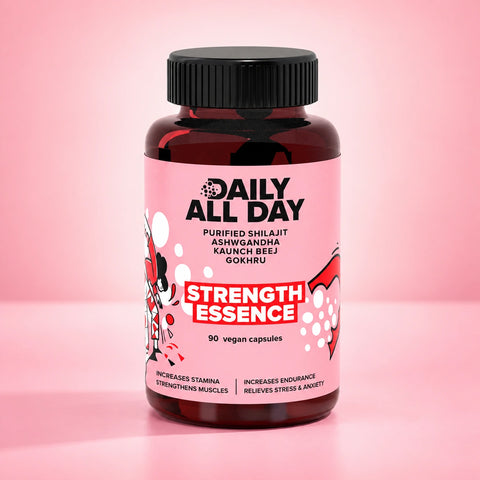
TL;DR: Ashwagandha's active withanolides help modulate the HPA axis, lowering cortisol so your nervous system can actually wind down at night. For working adults in India juggling commutes, deadlines, and disrupted sleep, Daily All Day's Strength Essence- Energy and Stamina Booster combines ashwagandha root extract with Shilajeet and Kaunch Beej for sustained, adaptogenic support.
Ashwagandha for Stress and Sleep for Working Adults India: What the Science Actually Says
India has a quiet sleep crisis. A 2023 survey by the Indian Sleep Disorders Association found that nearly 57% of urban working adults reported poor sleep quality, with work stress cited as the primary cause. If you're waking at 3 AM with your mind already running through tomorrow's to-do list, you're not alone, and you're probably already wondering whether ashwagandha for stress and sleep for working adults India is worth trying.
Here's the honest answer: ashwagandha is not a sedative and it is not an instant fix. What it does, over consistent weeks of use, is help your body recalibrate its stress response at a hormonal level. That recalibration is what eventually makes sleep easier, focus sharper, and Monday mornings slightly less grim.
What Is Ashwagandha and Why India Is Paying Attention Again
Ashwagandha (Withania somnifera) grows across the dry plains of Rajasthan, Madhya Pradesh, and Punjab. It has been used in traditional Ayurvedic practice for over 3,000 years, primarily as a Rasayana herb, which in Ayurvedic tradition means a substance used to support vitality and longevity. Charaka Samhita lists it as one of the foremost herbs for Vata-related imbalances, which traditionally include anxiety, restlessness, and disturbed sleep.
Modern science has spent the last two decades catching up. A 2012 randomised controlled trial published in the Indian Journal of Psychological Medicine (N=64 adults with chronic stress) found that participants taking ashwagandha root extract reported significantly lower perceived stress scores and serum cortisol compared to placebo. [1] A 2019 study of 60 adults published in Medicine (Baltimore) confirmed improvements in sleep onset latency and sleep quality with 120 mg of ashwagandha extract daily over eight weeks. [2]
What the top-ranking global pages rarely mention: most of the foundational research on ashwagandha was conducted with Indian or South Asian participants. This is not a herb that was studied in Western populations and then adapted for India. The evidence base is, quite literally, built here.
Ingredients Deep Dive: Withanolides and What They Do
The active compounds in ashwagandha root are called withanolides. These are naturally occurring steroidal lactones that interact with the hypothalamic-pituitary-adrenal (HPA) axis, essentially the chain of signals your body uses to produce cortisol when stressed.
When the HPA axis is chronically activated (think: back-to-back video calls, Bengaluru traffic, a screaming Slack notification at 11 PM), cortisol stays elevated into the night. High evening cortisol suppresses melatonin production. No melatonin, no deep sleep. Withanolides help modulate this feedback loop, so cortisol follows a more natural rhythm, rising in the morning and falling by evening.
A good ashwagandha supplement will specify the withanolide percentage. Look for 2.5% to 5% standardised root extract. Daily All Day's Strength Essence- Energy and Stamina Booster pairs ashwagandha root extract with Shilajeet (a fulvic acid-rich mineral resin traditionally used for stamina) and Kaunch Beej (known in Ayurveda for supporting mood and vitality). The combination is designed for sustained adaptogenic support, not a single-ingredient approach.
Top Benefits for Indian Working Adults
Ashwagandha for stress and sleep for working adults India is worth discussing beyond the generic benefits list. Here is what actually matters for the Indian context.
Cortisol Reduction for Chronic Work Stress
Multiple studies, including a 2021 randomised trial of 60 participants (Cureus journal), showed statistically significant reductions in serum cortisol after 8 weeks of ashwagandha use. [3] For someone working a hybrid schedule with irregular hours, this matters practically. Lower cortisol by evening means your body actually prepares for sleep instead of staying in alert mode.
Sleep Quality Without Sedation
This is the part most Indian readers get wrong. Ashwagandha does not cause daytime drowsiness in most people. It works on the root cause (elevated stress hormones) rather than forcing sedation. You remain sharp during the day and wind down naturally at night. That is the adaptogenic mechanism.
Sustained Energy Without Caffeine Spikes
Four cups of chai, a post-lunch coffee, and still foggy by 5 PM? That pattern is often stress-driven fatigue, not a caffeine deficiency. By supporting adrenal function, ashwagandha helps maintain steadier energy across the day. This is particularly relevant for work-from-home setups where the boundary between work and rest has largely collapsed.
Immune and Inflammation Support
Chronic stress suppresses immune function. Ashwagandha's withanolides have demonstrated anti-inflammatory activity in several lab and human studies. During the monsoon season, when infections circulate more freely in Indian metros, this is a practical secondary benefit worth noting.
How to Use Ashwagandha with Indian Meal Timings
This is the gap none of the top-five pages cover. Dosage timing relative to Indian meal patterns actually changes how well ashwagandha absorbs and how you experience it.
With fat helps absorption. Withanolides are lipophilic, meaning they absorb better in the presence of dietary fat. Taking ashwagandha with a meal that includes ghee, dahi, or any cooking oil improves bioavailability compared to taking it on an empty stomach with plain water.
Morning vs. night depends on your goal. If your primary concern is daytime stress and work focus, take Strength Essence in the morning with your breakfast (the one with paratha, poha, or eggs and ghee). If sleep is the bigger issue, take it 45 to 60 minutes before dinner or right after your last meal of the evening. Some people split the dose.
Capsule vs. churna vs. kadha. Traditional ashwagandha churna (powder) is widely available at Patanjali stores and local Ayurvedic shops. It is effective but the raw powder is intensely bitter and earthy, making consistency difficult. Kadha (decoction) preparations work but require preparation time most working adults simply do not have. Standardised capsules offer a consistent withanolide dose without the preparation overhead. This is why capsule-form supplements have become the practical default for ashwagandha for stress and sleep for working adults India.
30 / 60 / 90 Day Journey with Strength Essence
30 days: Most people notice the subtler changes first. Sleep onset may feel a little easier. The reactive spike of anxiety in a stressful meeting feels slightly less intense. Energy by mid-afternoon is marginally more stable. Do not expect dramatic shifts yet. The HPA axis takes time to recalibrate.
60 days: This is where the feedback from consistent users tends to become more concrete. Waking in the middle of the night becomes less frequent. Cortisol patterns begin normalising. Physical stamina during exercise or even long commutes improves. The Shilajeet and Kaunch Beej components of Strength Essence contribute meaningfully to this phase.
90 days: The research threshold. Most clinical trials on ashwagandha use 8 to 12 week durations for a reason. By 90 days of consistent daily use, the adaptogenic benefit is cumulative. Sleep architecture improves (more time in deep sleep stages). Perceived stress scores drop measurably. You are not relying on the supplement as a crutch; your body's own regulatory systems are functioning better.
For women in their 40s managing additional hormonal shifts alongside work stress, you may find this article on perimenopause brain fog, joint pinch, and sleep breaks useful alongside this guide.
Start Your 90-Day Ritual →Real Questions, Real Answers
-
How long does it take to notice the effects of Ashwagandha?
Subtle changes often appear by week 2 to 3. Meaningful improvements in sleep and stress typically show by week 6 to 8. The full benefit requires consistent use through 90 days. Patience here is not optional; it is the mechanism.
-
Does Ashwagandha make you feel tired or sleepy during the day?
For most people, no. It reduces the fatigue that comes from chronic stress rather than adding sedation. A small percentage of people do feel calmer in a way that reads as mild drowsiness initially. If that happens, shift your dose to evenings only.
-
Is it better to take Ashwagandha in the morning or at night?
With food, either works. Morning suits you if daytime stress and focus are your primary concerns. Evening suits you if sleep quality is the main goal. Taking it with a fat-containing meal improves absorption regardless of timing.
Frequently Asked Questions
Can I take ashwagandha with my thyroid or BP medication?
This is a genuinely important question that most guides skip. Ashwagandha may support thyroid hormone synthesis, which means if you are already on levothyroxine or other thyroid medications, your levels need monitoring if you add ashwagandha. Similarly, ashwagandha has mild blood-pressure-lowering properties. If you are already on antihypertensives, combining them without supervision may lower BP further than intended. Consult your physician or a qualified Ayurvedic practitioner before starting if you are on any ongoing prescription medication.
Is Strength Essence an FSSAI product or an AYUSH-licensed medicine?
Strength Essence- Energy and Stamina Booster is a dietary supplement registered under FSSAI, not a licensed AYUSH medicine. This means it is regulated as a nutraceutical under Indian food safety law. It supports general wellness and energy, but it does not carry medicinal claims. If you are looking for a prescribed Ayurvedic medicine for a specific condition, consult a registered Ayurvedic practitioner for that purpose.
Should I adjust ashwagandha use during summer, monsoon, or winter in India?
Traditional Ayurvedic seasonal guidelines (ritucharya) suggest ashwagandha is particularly well-suited to Sharad and Hemant Ritu (autumn and early winter), when Vata tends to be more aggravated and stress-related issues more common. In peak Indian summer (April to June), some practitioners recommend pairing ashwagandha with cooling foods like dahi or coconut water to balance its slightly warming nature. During monsoon, when digestion can be sluggish, taking it with warm milk or a light meal rather than on an empty stomach is generally advisable. That said, consistent year-round use is what the clinical evidence supports for sustained benefit.
I already take Brahmi or Shatavari. Can I combine them with ashwagandha?
Brahmi (Bacopa monnieri) and ashwagandha are commonly combined in Ayurvedic formulations, and the combination is generally well-tolerated. Brahmi is primarily a cognitive herb, ashwagandha is primarily adaptogenic, and they complement each other without known antagonistic interactions. Shatavari is primarily used for hormonal support in women and also combines well with ashwagandha. However, if you are taking multiple Ayurvedic herbs simultaneously, keeping a practitioner in the loop helps you avoid duplicating effects or inadvertently exceeding reasonable supplementation levels.
Is ashwagandha safe during pregnancy or while breastfeeding?
No. Ashwagandha is not recommended during pregnancy or while breastfeeding. Traditional Ayurvedic texts flag it as a uterine stimulant, and it should be avoided across all trimesters. If you are pregnant, nursing, or planning conception, please consult your gynaecologist or a registered doctor before taking any herbal supplement. This is non-negotiable regardless of the supplement form or brand.
How is ashwagandha for stress and sleep for working adults India different from just taking melatonin?
Melatonin directly supplements the sleep hormone and works best for short-term circadian disruptions (jet lag, shift work). It does not address the cortisol elevation that is causing the sleep problem in the first place. Ashwagandha works upstream by modulating the HPA axis, so your body's natural melatonin production is no longer suppressed by elevated evening cortisol. For chronic stress-driven sleep issues in working adults, ashwagandha addresses the root physiological pattern rather than substituting one hormone. That said, they work through different mechanisms and are not mutually exclusive if used under guidance.

The Practical Summary
Ashwagandha for stress and sleep for working adults India is one of the better-researched natural options available, with an evidence base rooted in Indian-population studies, not imported Western research. The withanolides in ashwagandha root work by modulating your cortisol rhythm, which is the upstream cause of both chronic stress and disrupted sleep in most working adults.
Take it consistently with a fat-containing meal. Give it 90 days. Adjust timing based on whether stress or sleep is your bigger priority. If you are on thyroid or BP medication, loop in your doctor first. And choose a supplement, like Strength Essence- Energy and Stamina Booster, that specifies standardised root extract rather than leaf powder or unspecified plant parts.
That is the unglamorous, practical truth. No shortcuts, but real, cumulative support for a body that is asked to do too much.
References:
[1] Chandrasekhar K, Kapoor J, Anishetty S. A prospective, randomized double-blind, placebo-controlled study of safety and efficacy of a high-concentration full-spectrum extract of ashwagandha root in reducing stress and anxiety in adults. Indian J Psychol Med. 2012;34(3):255-262. N=64.