Can Ashwagandha Capsules Relieve Stress in India?
Share
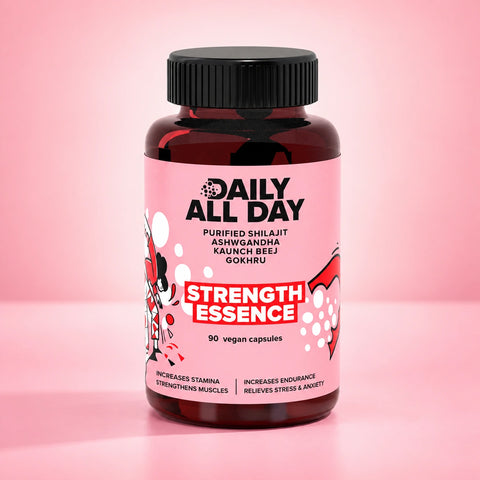
Bottom line: Ashwagandha capsules for stress relief in India work through withanolides, active compounds in Withania somnifera root that help regulate cortisol, the body's primary stress hormone. Daily All Day's Strength Essence Energy and Stamina Booster combines ashwagandha with shilajit and kaunch beej, supporting steadier energy, calmer focus, and better sleep quality over 60 to 90 days of consistent use.
Can Ashwagandha Capsules Relieve Stress in India?
A 2023 survey by the Indian Psychiatry Society found that nearly 74% of urban Indian adults reported clinically significant stress levels, with Bengaluru, Mumbai, and Delhi topping the list. That number is not surprising. The 7 AM call from a Noida client, the 11 PM Slack ping from a Pune manager, the Diwali sweets you ate while still fielding work emails — stress in India wears many faces. And yet, most popular resources on ashwagandha capsules for stress relief in India keep pointing to Western study populations and skip the context that actually matters to you: your meals, your seasons, your medications, your daily rhythm.
This post fills those gaps directly.
What Is Ashwagandha? The Adaptogen Urban India Needs
Ashwagandha (Withania somnifera) is a small root-bearing shrub native to the dry plains of Rajasthan, Madhya Pradesh, and parts of the Deccan. It has been documented in Charaka Samhita as a rasayana, a class of Ayurvedic formulations traditionally used to support vitality and resilience. It is not a sedative. It does not force calm. It belongs to a category of botanicals called adaptogens, which work by supporting your body's own stress-response systems rather than overriding them.
This matters in the Indian context because the stressors here are layered: monsoon humidity triggering lethargy, festival-season eating disrupting sleep cycles, air pollution in Delhi NCR taxing cellular recovery, and work-from-home blurring the line between rest and output. An adaptogen works with that complexity. A sedative just masks it.
Capsule form is worth noting here. Ashwagandha is available in India as churna (powder), kadha (decoction), liquid extract, and standardised capsules. Churna is the traditional route, often mixed into warm milk with ghee, a genuinely effective delivery method but one that requires daily effort and has a strong, earthy taste many people find difficult to sustain. Kadha is seasonal, popular in winters but impractical in humid Chennai summers. Capsules offer a standardised dose of withanolides (the active compounds) without the taste barrier, which is why they show better long-term adherence for the working adult.
Daily All Day's Strength Essence Energy and Stamina Booster uses ashwagandha root extract alongside shilajit and kaunch beej, a combination that traditional Ayurvedic texts reference for supporting both mental steadiness and physical stamina. It is manufactured under FSSAI guidelines as a dietary supplement, not an AYUSH-licensed medicine. That distinction matters: AYUSH-licensed products make therapeutic drug claims; FSSAI supplements support general wellbeing. If you see a product claiming to "treat anxiety disorder," it is either making an unlicensed claim or is a licensed medicine requiring a doctor's prescription.
Withanolides and Cortisol: The Science Behind the Calm
The active constituents responsible for ashwagandha's stress-support effects are steroidal lactones called withanolides. They act on the hypothalamic-pituitary-adrenal (HPA) axis, the biological pathway your body uses to mount a stress response and release cortisol.
Cortisol is not the enemy. Short bursts of it keep you sharp in a crisis. The problem is chronic elevation: cortisol that stays high because your inbox never empties, your commute never shortens, and your body never fully signals safety. Sustained high cortisol is associated with disrupted sleep, fatigue, and difficulty maintaining a stable mood.
A 2019 randomised, double-blind, placebo-controlled study of 60 adults published in Medicine found that 240 mg of ashwagandha root extract daily significantly reduced serum cortisol, perceived stress scores, and morning cortisol levels compared to placebo over 60 days. [1]
A 2012 AIIMS-affiliated study of 64 adults with a history of chronic stress found that 300 mg of KSM-66 ashwagandha root extract twice daily for 60 days produced significant reductions in stress assessment scores and serum cortisol. [2]
A 2021 study of 80 participants published in PLOS ONE confirmed that 300 mg ashwagandha root extract twice daily improved sleep onset latency, sleep quality, and morning alertness over 8 weeks. [3]
Ashwagandha capsules for stress relief in India are increasingly backed by Indian-population data, not just global studies. That matters because Indian adults have specific dietary contexts: a predominantly rice-wheat-dal-based diet, regular ghee and dahi consumption, and widely varying meal timings. None of the top-ranking Indian supplement pages address whether these foods affect absorption. Here's the short answer: ashwagandha extract is fat-soluble, meaning taking it with a meal that contains some fat (your dal-tadka with ghee, your dahi rice) improves absorption compared to taking it on an empty stomach.
Top Benefits of Ashwagandha Capsules for the Indian Lifestyle
1. Cortisol Support for the Chronic Deadline Cycle
The work-from-home reality in Indian metros means many adults never fully leave the office. Ashwagandha for cortisol management in India is perhaps its most studied application. Consistent daily use over 60 days shows measurable reductions in perceived stress without sedation, meaning you stay functional, not foggy.
2. Sleep Quality Without Dependency
Unlike melatonin supplements, ashwagandha does not directly induce sleep. It supports sleep by calming the HPA axis, so your body can transition into rest more naturally. Particularly useful during exam season, post-Diwali schedule resets, or during project crunch periods.
3. Stamina Support for Physical and Mental Fatigue
The best ashwagandha supplement for work-from-home fatigue is one that addresses both ends: the mental tiredness of back-to-back video calls and the physical lethargy from sitting for 10 hours. Withanolides support mitochondrial function, which is how your cells produce energy. Shilajit, included in Strength Essence, contributes fulvic acid that further supports this process.
4. Cognitive Steadiness Under Pressure
Ashwagandha adaptogen benefits for urban India include improved reaction time, working memory, and sustained attention, all documented in peer-reviewed settings. For the professional managing four projects simultaneously, this is not a small thing.
5. Seasonal Resilience
Ayurvedic seasonal guidelines (ritucharya) suggest that the body's adaptability shifts across seasons. Winters in North India naturally call for warming, strengthening herbs. Summers and the humid monsoon months call for lighter support. Ashwagandha is considered a warming herb in Ayurvedic classification, making it particularly well-suited to autumn and winter use. During peak summer, especially in coastal cities with high humidity, some practitioners recommend a slightly lower dose or pairing it with cooling foods like dahi. Always check with a qualified Ayurvedic practitioner if you are adjusting seasonal use.
How to Use Strength Essence with Indian Meal Timings
Timing matters more than most supplement guides admit. Here is how it maps to typical Indian eating patterns:
- Morning (with breakfast, 7–9 AM): Best for energy and cortisol support through the workday. Take with your paratha-and-dahi breakfast or even a simple roti-sabzi. The fat content improves absorption. Avoid taking on an empty stomach initially, especially if you have a sensitive digestive system.
- Post-lunch (1–2 PM): A split dose strategy works well for consistent cortisol support. Your dal-rice or rajma-chawal lunch provides enough fat and protein to support absorption without heaviness.
- Before bed (9–10 PM): If your primary goal is sleep quality, a single dose 45–60 minutes before bed is widely used. Pair it with warm milk if that is your routine. The traditional ashwagandha doodh combination is practically sound, the fat in milk supports withanolide absorption.
Follow the dosage on your Strength Essence pack. Do not double-dose to speed up results. Adaptogens build effect gradually. That is their mechanism, not a flaw.
The 30 / 60 / 90 Day Journey
30 days: Most people notice subtle shifts: slightly easier to wind down at night, less of that mid-afternoon mental fog. Sleep may feel marginally deeper. Cortisol spikes during stressful moments may feel less consuming. Do not expect dramatic changes yet. Consistency is the point at this stage.
60 days: This is where the research shows the most measurable changes in serum cortisol and perceived stress scores. You may notice you are reacting less sharply to triggers that would have derailed your day a month ago. Physical stamina during exercise or long workdays may feel more stable. Sleep onset (time to fall asleep) often improves significantly around this mark.
90 days: The compounding effect becomes clear. Withanolides stress support in India is most pronounced with consistent 90-day use, after which a 2–4 week rest cycle is commonly recommended before resuming. At this stage, users typically report a baseline shift: less background anxiety, more even energy across the day, and better recovery from physically or mentally demanding stretches.
If you are navigating stress alongside perimenopause, it is worth reading about how Indian women 40+ manage brain fog, joint discomfort, and sleep disruption, as ashwagandha often features in that broader support picture too.
Quora Questions, Answered Honestly
1. How long does it take for ashwagandha to work? (Source)
Subtle shifts in sleep and mood often appear within 2–4 weeks. Measurable cortisol reduction and consistent energy changes are typically reported at the 60-day mark. Full adaptogenic benefit builds over 90 days of daily use. It is not a fast-acting anxiolytic. It is a gradual, cumulative support system.
2. What is the best time to take ashwagandha? (Source)
With a meal containing some fat, morning or night, depending on your primary goal. Morning for daytime stamina and cortisol balance; evening for sleep quality. A split morning-and-night dose works well for comprehensive support and maps naturally to Indian two-meal patterns.
3. Is it okay to take ashwagandha every day? (Source)
Yes, for most healthy adults, daily use for up to 90 days is well-tolerated in published studies. A short break after 90 days is commonly recommended. If you are on thyroid medication, antihypertensives, or immunosuppressants, consult your doctor before starting. Ashwagandha can interact with thyroid hormone levels and may amplify the effect of sedative medications.
Frequently Asked Questions
Should I take ashwagandha capsules before or after meals in the Indian diet context?
Take it after a meal that contains some fat, because withanolides (the active compounds) are fat-soluble and absorb better with dietary fat. Your standard Indian meals already provide this: ghee in dal, fat in dahi, oil in sabzi. Taking it on a completely empty stomach can occasionally cause mild gastric discomfort in people with sensitive digestion. If your breakfast is just black chai, wait for your actual meal before taking your capsule.
Can I take ashwagandha if I am already on thyroid medication or BP tablets?
This is an important question that most Indian supplement pages skip entirely. Ashwagandha may influence thyroid hormone levels, specifically TSH and T4, according to some studies. If you are on levothyroxine or any thyroid medication, consult your doctor before adding ashwagandha. Similarly, if you are on antihypertensive medication, ashwagandha's mild blood-pressure-supportive effect may compound it. This is not a reason to avoid it categorically, but your doctor needs to know. People on diabetes medications should also monitor blood sugar levels, as ashwagandha may contribute to blood glucose changes. Never adjust prescription medication based on a supplement alone.
Is ashwagandha use different in Indian summers versus winters?
In Ayurvedic tradition, ashwagandha is classified as a warming herb (ushna virya). This makes it particularly well-suited for use during the cooler months, from October through February across most of India. In peak summer (April, June) or during humid monsoon months, some Ayurvedic practitioners recommend a slightly reduced dose or pairing with cooling foods like dahi or coconut water to balance its warming quality. There is no published clinical evidence mandating seasonal dose adjustment, but if you feel unusually warm, experience acidity, or feel restless after starting in summer, reduce your dose and consult a qualified practitioner.
What is the difference between an FSSAI supplement and an AYUSH-approved medicine? Which is Strength Essence?
This confuses a lot of Indian buyers. FSSAI (Food Safety and Standards Authority of India) licenses dietary supplements, which support general wellbeing but cannot claim to treat, cure, or diagnose any condition. AYUSH-licensed products are classified as medicines under the Drugs and Cosmetics Act and can make specific therapeutic claims within their licensed scope, but they require stricter manufacturing and clinical evidence standards. Daily All Day's Strength Essence Energy and Stamina Booster is an FSSAI-compliant dietary supplement. It supports stress resilience, stamina, and energy as part of a balanced lifestyle. It is not a substitute for prescribed medicine and does not claim to treat any medical condition.
Who should not take ashwagandha capsules?
Pregnant women should avoid ashwagandha. Traditional texts and some modern studies note its potential uterotonic properties, and no trimester is considered safe without medical clearance. Breastfeeding mothers should consult a registered doctor before use. People with autoimmune conditions (such as rheumatoid arthritis or lupus) should use caution, as ashwagandha may stimulate immune activity. Those scheduled for surgery should stop use at least two weeks before the procedure due to potential interactions with anaesthesia. Children and adolescents under 18 should not use adult-formulated supplements without medical guidance.
How does ashwagandha compare to brahmi or shatavari, which many Indian households already use?
These are different herbs with different primary actions. Brahmi (Bacopa monnieri) is primarily used in Ayurveda for cognitive support, specifically memory and learning, with a cooling quality. Ashwagandha is more associated with energy, physical stamina, and cortisol balance. Shatavari is traditionally used for hormonal and reproductive support, especially in women, with a nourishing, cooling quality. They are not interchangeable. Some Ayurvedic formulations combine ashwagandha and brahmi for both energy and cognition support, but combining supplements without guidance from a qualified practitioner is not recommended, especially if you are already on prescription medication.