Which Ashwagandha Tablet Best Relieves Daily Stress?
Share
TL;DR: Ashwagandha tablets for daily stress relief in India work by supporting your body's cortisol regulation through withanolides, the active compounds in Withania somnifera root. Daily All Day's Strength Essence, an Energy and Stamina Booster combining ashwagandha, shilajit, and kaunch beej, may help reduce fatigue and support calmer energy with consistent daily use.
Which Ashwagandha Tablet Best Relieves Daily Stress?
It is 11:30 PM. You just got back from a long day — back-to-back calls, a commute that stretched to 90 minutes, and dinner eaten cold on the couch. Your mind is still running. Sleep feels far away. If this is Tuesday, not some rare bad day, your cortisol rhythm may genuinely need support. This is exactly the kind of chronic low-grade stress that ashwagandha tablets for daily stress relief in India are designed to address, not as a quick fix, but as a consistent daily practice.
Most articles you find online talk about ashwagandha in general terms. What they skip is the detail that actually matters to you: when to take it relative to your roti-dal-rice routine, whether your thyroid medication changes things, and what months of consistent use actually look like. We cover all of that here.
What is Ashwagandha?
Ashwagandha (Withania somnifera), sometimes called Indian ginseng, is a small shrub native to India, found especially in Rajasthan, Madhya Pradesh, and parts of Maharashtra. Its root has been used in traditional Ayurvedic practice for over 3,000 years, primarily as a rasayana (rejuvenating tonic) to support strength, stamina, and mental calm.
- Classified as an adaptogen: supports the body's ability to respond to physical and mental stress
- Root extract is the part used in quality supplements (not the leaf)
- Available as powder, tablets, capsules, and liquid extracts
Today it is one of the most-searched best ashwagandha supplements in India for 2025, and with good reason. The science has caught up to the tradition. Notably, it is sold as a dietary supplement under FSSAI regulations, not as an AYUSH-licensed medicine. That distinction matters when you are comparing products (more on that in the FAQ below).
Ashwagandha and Stress Relief: How Does It Work?
Stress is not just a feeling. It is a hormonal cascade. When you are under pressure, your adrenal glands release cortisol. Short bursts are fine. Sustained high cortisol, the kind that comes from months of deadlines, city noise, and disrupted sleep, begins to affect your energy, focus, and sleep quality.
Ashwagandha's withanolides act on the hypothalamic-pituitary-adrenal (HPA) axis, the system that regulates cortisol output. A 2019 double-blind, placebo-controlled trial of 60 adults found that 240 mg of standardised ashwagandha root extract daily significantly reduced morning cortisol levels compared to placebo. [1]
A separate study tracking ashwagandha cortisol levels in India-relevant populations found that fatigue reduction was one of the most consistent outcomes, even when self-reported stress scores varied. [6] This aligns with what the NIH Office of Dietary Supplements notes: ashwagandha shows stronger evidence for reducing fatigue than for perceived stress scores. [ref]
Put simply: you may not feel suddenly "stress-free," but your body's stress-response system gets more regulated over time. That shows up as better sleep, less 3 PM energy crashes, and a calmer baseline.
Ingredients Deep Dive: The Science Inside Ashwagandha
Withanolides are the primary bioactives. They modulate the HPA axis, support GABA-like calming signals in the brain, and help reduce inflammatory markers linked to chronic stress. [2]
Sitoindosides and alkaloids support cognitive function and faster physiological recovery from stress. Antioxidants in the root also help manage oxidative stress, which spikes in high-pollution urban environments (relevant if you are in Delhi, Mumbai, or Bengaluru for most of the year).
One important note: root extract, not leaf extract, is what clinical studies use. Products using the leaf are cheaper to manufacture but carry a different, less well-studied safety profile. [5] Always check what part of the plant your supplement uses.
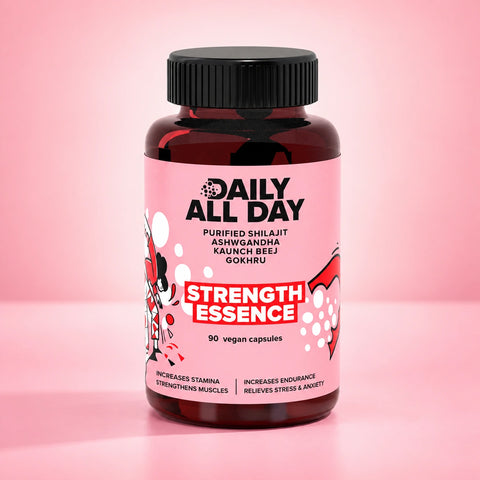
Daily All Day's Strength Essence uses ashwagandha root extract, paired with shilajit (for mitochondrial energy support), kaunch beej (for dopamine pathway support), and gokhru. The combination addresses both the stress response and the energy depletion that usually comes with it.
Health Benefits of Ashwagandha
- Supports cortisol regulation: Helps the body maintain a healthier stress-hormone rhythm with consistent use. [1]
- May reduce fatigue: Particularly useful for work-from-home professionals and those with irregular sleep schedules. [6]
- Supports sleep quality: By moderating the cortisol spike that can keep you alert at night.
- Stamina and physical performance: A 2021 study of 50 healthy adults found improved cardiorespiratory endurance with 300 mg twice daily. [3]
- Cognitive clarity: Users consistently report better focus after 6 to 8 weeks. Memory and reaction time have shown modest improvements in controlled trials.
- Anti-inflammatory support: Withanolides may help reduce inflammatory markers, relevant for joint comfort and post-exercise recovery. [4]
Note: These are supplement-level benefits under traditional Ayurvedic use and supporting research. Ashwagandha is not a medicine and does not treat or diagnose any condition.
Dosage and Indian Meal Timing
Most competing pages list dosage ranges. None of them tell you when to take ashwagandha relative to typical Indian meal patterns. That timing gap matters for absorption and for avoiding the one common side effect: mild stomach upset.
General dosage range: 300 to 600 mg of standardised root extract daily, in one or two doses. Clinical trials used 200 to 300 mg twice daily for 8 to 12 weeks as a safe, well-tolerated protocol. [2]
With Indian meals, here is what works practically:
- After breakfast (poha, idli, paratha, or even just chai with toast): Take the first capsule. Fat from ghee or dahi in a typical Indian breakfast may improve absorption of fat-soluble withanolides.
- After dinner: Take the second capsule. Evening dosing may support sleep quality by helping cortisol taper as intended through the night.
- Empty stomach: Not recommended. More likely to cause nausea or loose motions, especially with spicy or heavy Indian evening meals.
For Strength Essence (Energy and Stamina Booster): 1 capsule after breakfast, 1 capsule after dinner.
Ashwagandha dosage for work stress in India: If your stress is primarily mental (back-to-back meetings, decision fatigue), 300 mg twice daily after meals is a reasonable starting point. Consistency matters more than dose size.
Seasonal note: In Ayurveda's ritucharya framework, ashwagandha is traditionally emphasised in sharad (autumn) and shishir (winter) as a warming, grounding tonic. In peak Indian summer (April to June), some practitioners suggest a short break or reduced dose, particularly for pitta-dominant individuals who already run warm. This is traditional guidance, not a medical instruction. Speak with a qualified Ayurvedic practitioner if you want personalised seasonal advice.
30 / 60 / 90 Day Timeline
30 days: Most users notice better sleep quality and a slight reduction in that wired-but-tired feeling late at night. Energy on waking may improve modestly. Cortisol-related changes are beginning internally but may not feel dramatic yet.
60 days: The clearer window. Fatigue reduction is more noticeable. Focus during work hours tends to feel more stable. Physical stamina (gym, walks, climbing stairs without breathlessness) may show measurable improvement. A 2021 trial of 60 adults confirmed significant fatigue reduction by week 8. [3]
90 days: The most consistent results appear here. Cortisol rhythm is more stable. Mood baseline is calmer. Several Indian users in online communities report this as the point where they notice the difference most clearly on high-stress days because the peaks feel less overwhelming. Continuing beyond 90 days is generally considered safe with the root extract at recommended doses.
Side Effects and Safety
Ashwagandha root extract is well-tolerated by most healthy adults at recommended doses. [5] That said, a few situations need your attention.
- Mild stomach upset: Most common side effect, usually resolved by taking it after meals rather than on an empty stomach.
- Thyroid medication: Ashwagandha may influence thyroid hormone levels. If you take levothyroxine or have hypothyroidism or hyperthyroidism, consult your doctor before starting. Do not self-adjust. [4]
- Blood pressure medication: Ashwagandha has mild adaptogenic effects that may interact with antihypertensives. Check with your doctor if you are on BP medication.
- Sedatives or anti-anxiety medications: Potential additive effect. Do not combine without medical guidance.
- Pregnancy and nursing: Avoid use during pregnancy. Traditional Ayurvedic texts flag ashwagandha as potentially uterine-stimulating. If you are nursing, consult a registered doctor or qualified Ayurvedic practitioner before use.
- Post-surgery: Pause use at least two weeks before any scheduled surgery, as it may interact with anaesthesia or affect bleeding time.
- Liver concern: Rare cases of liver enzyme elevation have been reported, mostly linked to very high doses or non-root plant parts. Stick to root extract at recommended doses and discontinue if you notice jaundice or unusual fatigue.
Ashwagandha QnA (Quora Insights)
- What are the real benefits and side effects? Real users consistently report stress reduction, better sleep, and improved energy as the top three benefits. Gastric discomfort is the most common complaint. Read the Quora thread.
- What exactly is ashwagandha? A traditional Ayurvedic adaptogen used for strength and calm. More on Quora.
- Does ashwagandha reduce anxiety and what is the right dose? Many users report 300 to 600 mg daily as effective for anxiety support. Results take 4 to 8 weeks. See Quora discussion.
- Side effects people have actually experienced: Mostly mild and dose-related. Loose motions and drowsiness are reported occasionally. Quora side-effects thread.
- NIH professional fact sheet: Confirms fatigue reduction is a more consistent finding than perceived stress reduction across trials. Read the NIH factsheet.
Daily All Day Ashwagandha Products
We formulate our supplements as FSSAI-registered dietary supplements, not AYUSH-licensed medicines. That means we are held to food-safety and labelling standards, with full ingredient transparency on every pack.
Strength Essence, Energy and Stamina Booster (90 Capsules)
- Each capsule: 150 mg ashwagandha root extract, 100 mg shilajit, 125 mg gokhru, 125 mg kaunch beej
- Supports stamina, stress response, and reduced fatigue
- Vegetarian, lab-tested, no artificial fillers
- Recommended use: 1 capsule after breakfast, 1 after dinner
Try Strength Essence, Energy and Stamina Booster →
Frequently Asked Questions
Should I take ashwagandha before or after meals, given that Indian dinners are often late and heavy?
Always take ashwagandha after meals, not before. Indian dinners tend to be the largest meal of the day, often eaten at 9 to 10 PM, and the fat content in a typical dal-sabzi-roti meal actually aids absorption of withanolides. Taking it on an empty stomach increases the chance of nausea or loose motions. If your dinner is very late, splitting your dose (one after lunch, one after dinner) works well too.
I am on thyroid medication (levothyroxine). Can I take ashwagandha tablets for daily stress relief in India?
Not without checking with your doctor first. Ashwagandha may influence thyroid hormone production, and combining it with levothyroxine without monitoring could alter your thyroid levels in either direction. This is not a reason to avoid it permanently, but your doctor should know you are adding it and may want to recheck your TSH after 4 to 6 weeks. The same caution applies if you have hyperthyroidism.
Is this an FSSAI product or an AYUSH-licensed medicine? Why does it matter?
This is an important question most Indian shoppers never ask. Daily All Day Strength Essence is registered as an FSSAI dietary supplement, not an AYUSH-licensed medicine. AYUSH-licensed products are regulated differently and can make specific therapeutic claims under that framework. FSSAI supplements are held to food-safety and labelling standards and use framing like "supports" or "may help maintain," not "treats" or "cures." Neither is automatically better; they serve different purposes. For general wellness support, a quality FSSAI supplement with transparent labelling is appropriate for most healthy adults.
Should I use ashwagandha differently in summer versus monsoon versus winter in India?
Traditional Ayurvedic seasonal guidance (ritucharya) does suggest adjusting adaptogens by season. Ashwagandha is traditionally considered warming and grounding, making it especially suitable through sharad (October to November) and shishir (winter months). During peak Indian summer, pitta-dominant individuals who already feel overheated may consider a shorter cycle or a reduced dose. Monsoon season (June to September) does not have a strong contraindication, but humidity-related digestive sluggishness is common, so taking it after a proper meal matters more than ever. These are traditional guidelines. Consult a qualified Ayurvedic practitioner for personalised seasonal advice.
Who should not take ashwagandha at all, even at low doses?
Pregnant women should avoid it. Traditional Ayurvedic texts flag it as potentially uterine-stimulating, and there is insufficient clinical safety data for pregnancy. Breastfeeding mothers should consult a registered doctor before use. People scheduled for surgery should stop at least two weeks prior. Those on sedatives, immunosuppressants, or antihypertensives should get medical clearance first. Children and adolescents under 18 should only use it under a doctor's supervision.
When should I realistically expect to notice a difference with daily use?
Most people notice improved sleep quality and slightly less evening fatigue within the first 30 days. More meaningful changes in stress resilience and sustained energy tend to show up between 60 and 90 days of consistent use. A 2021 clinical trial of 60 adults confirmed significant fatigue reduction by week 8. [3] If you notice no change after 90 days at the recommended dose, it is worth speaking with a doctor about whether stress has an underlying cause that needs separate attention.