Can Ashwagandha Fix Your Afternoon Energy Crash?
Share
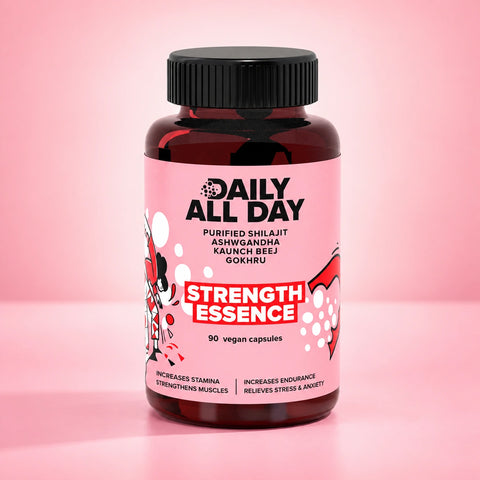
Short answer: Ashwagandha, an adaptogenic herb used in Ayurveda for centuries, helps support steady energy by balancing cortisol rather than spiking it. Unlike caffeine, it does not cause a rebound crash. Strength Essence, Energy and Stamina Booster by Daily All Day combines ashwagandha with Shilajit, Gokhru, and Kaunch Beej for sustained, natural vitality.
Can Ashwagandha Fix Your Afternoon Energy Crash? Ashwagandha for Energy Without Caffeine Crash India
That Familiar Feeling: The Post-Coffee Slump
It's 3:15 PM in your Bengaluru tech park. The AC is running full blast, your lunch dabba is empty, and the words on your screen have stopped making sense. You had two cups of filter coffee before noon. Now your head feels like wet cotton. Sound familiar?
This is not weakness. It is basic biology, and millions of working adults across Indian metros experience it every single day. The pattern goes: chai or coffee at 8 AM, another at 11, brief alertness, then a wall at 2 or 3 PM. Many people then reach for a third cup, only to find themselves wide awake at midnight and exhausted again by next afternoon.
There is a smarter path. Ashwagandha for energy without caffeine crash is not a new concept in India. Ayurvedic physicians have recommended Withania somnifera for fatigue and stamina for well over 3,000 years. What is newer is the peer-reviewed science backing it up, and the practical question of how to actually use it alongside your dal-chawal-roti lifestyle.
This post fills three specific gaps that most other Indian wellness articles skip: how ashwagandha interacts with common Indian meal timings and food pairings, what Indian-population research actually says, and who should not take it (the list is short but important).
What Exactly Is a Caffeine Crash?
Caffeine does not give you energy. It borrows it. Here is what actually happens inside your brain.
Your brain produces a compound called adenosine throughout the day. Adenosine builds up gradually and signals sleepiness. Caffeine works by sitting in adenosine's receptor seat, blocking the signal. You feel alert. But adenosine keeps accumulating in the background. The moment caffeine clears your system, that backlog floods the receptors all at once. The crash is not the caffeine leaving. It is all the suppressed fatigue arriving at the same moment.
Your adrenal glands also play a role. Caffeine triggers a mild adrenaline release, raising your heart rate and sharpening focus briefly. But adrenal stimulation is not sustainable across 8 to 10 hours of office work. After repeated stimulation, the system quiets down, and you feel that flat, foggy feeling that no amount of willpower fixes.
This is why ashwagandha for energy without caffeine crash is such a different proposition. Ashwagandha works on cortisol, the longer-acting stress hormone, not on adenosine receptors. It does not spike anything sharply. It supports your baseline.
A 2019 randomised controlled trial published in Medicine (Baltimore) studied 60 adults over 8 weeks. Participants who took ashwagandha root extract reported significantly better energy, sleep quality, and stress scores compared to placebo, with no crash effect noted.[1] A 2015 study in the Journal of the International Society of Sports Nutrition, involving 57 male participants in India, found that ashwagandha supplementation was associated with significantly improved cardiorespiratory endurance and recovery.[2]
How to Avoid the 3 PM Crash: Practical Steps for Indian Lifestyles (ashwagandha for energy without caffeine crash india)
Most global advice on energy crashes assumes a Western meal pattern: cereal at 7, sandwich at noon, dinner at 6. Indian meal timing looks very different, and that matters for how you structure your supplement and food choices.
Pair Your Morning Capsule With Breakfast, Not an Empty Stomach
A typical Indian breakfast, whether poha, idli-sambar, or paratha with dahi, contains a mix of carbohydrates and protein. Taking ashwagandha capsules with this meal slows absorption slightly and reduces any chance of mild gastric discomfort, which a small percentage of people notice on an empty stomach. If you skip breakfast entirely (common in metro morning rush), take the capsule with a handful of nuts or a glass of warm milk with a little ghee.
Ghee is worth mentioning specifically. Traditional Ayurvedic formulations often combine ashwagandha with warm milk and a small amount of fat, because certain active withanolides in the herb are lipophilic. They absorb better in the presence of dietary fat. Your desi ghee is doing real biochemical work here.
Limit Caffeine After 1 PM
This one is practical, not preachy. Caffeine's half-life in your body is roughly 5 to 6 hours. A 2 PM cup means half the caffeine is still circulating at 8 PM, disrupting the deep sleep your body needs to restore energy for tomorrow. Poor sleep creates tomorrow's crash before it even starts.
Replace the post-lunch chai with a short 10-minute walk, a glass of water with a pinch of rock salt, or herbal kadha if you have it.
Watch the Festival Eating Cycles
Diwali week, Eid feasting, Navratri fasting and feasting, Karwa Chauth fasting. Indian adults go through dramatic caloric swings across the year. During high-sugar festival eating, your blood glucose spikes and dips more sharply, which amplifies the afternoon crash feeling even without caffeine. Adaptogens like ashwagandha support cortisol balance during these periods, which is when many people notice their supplement working most noticeably.
Hydration in AC Offices and Polluted Commutes
Dehydration is underrated as an energy drain. Mumbai and Delhi pollution, long metro commutes, and sealed AC offices all contribute to mild chronic dehydration. Even 2% dehydration measurably reduces cognitive performance. Drink water before you reach for a second coffee.
Ingredients Deep Dive: What Is Actually in Strength Essence
The best natural energy booster without coffee in India is not a single herb. It is a thoughtfully combined formula. Here is what each ingredient in Strength Essence, Energy and Stamina Booster contributes, and the science behind it.
Ashwagandha (Withania somnifera) — 150 mg
Ashwagandha is classified as a Rasayana in Ayurveda, meaning a herb used to support vitality and longevity. Its primary active compounds, withanolides, appear to modulate the HPA (hypothalamic-pituitary-adrenal) axis. That means they help your body regulate how much cortisol it produces under stress. Lower, steadier cortisol means less energy depletion over the day. No spike, no crash. This is the core reason ashwagandha for energy without caffeine crash india makes sense as a category, not just a marketing phrase.[3]
Shilajit — 100 mg
Shilajit is a resinous mineral compound found in Himalayan rock formations. It is rich in fulvic acid and over 80 trace minerals. Fulvic acid supports mitochondrial function, which is how your cells actually produce ATP, your body's energy currency. This is cellular-level support, not stimulation. Think of it as helping your internal power plant run more efficiently.
Gokhru (Tribulus terrestris) — 125 mg
Gokhru has been used in Ayurvedic practice to support physical stamina and muscle function. It is traditionally recommended for men experiencing fatigue, low drive, or reduced physical output. Modern research suggests it may support testosterone levels within a normal physiological range, which is relevant for energy and recovery.
Kaunch Beej (Mucuna pruriens) , 125 mg
Kaunch Beej is a natural source of L-DOPA, a precursor to dopamine. Dopamine is not just a "feel good" molecule. It is central to motivation, focus, and the drive to initiate tasks. Low dopamine tone is one reason people feel flat and unmotivated in the afternoon even when they are not technically tired. Kaunch Beej supports mood and mental energy, which complements ashwagandha's physical stamina support.
Together, these four herbs address ashwagandha capsules for afternoon fatigue from multiple angles: stress hormone balance, cellular energy production, physical stamina, and neurochemical motivation.
Meet Your Ally for All-Day Vitality
Strength Essence, Energy and Stamina Booster by Daily All Day brings together all four herbs above in a single daily capsule, FSSAI-registered, vegetarian, and manufactured under GMP-certified conditions.
A note on the FSSAI versus AYUSH question that confuses many Indian buyers: Strength Essence is a dietary supplement registered under FSSAI, not a licensed AYUSH medicine. This means it meets food safety standards for ingredients, labelling, and manufacturing. It is not making medicinal claims, and you do not need a prescription to use it. If you are already on prescription medications for thyroid, blood pressure, or diabetes, check with your doctor before adding any supplement, including this one.
30 / 60 / 90 Day Timeline: What to Expect
Adaptogens are not caffeine. They build, rather than spike. Here is a realistic picture based on what users typically report and what the clinical literature suggests.
30 days: Most people notice improved sleep quality first. You may find it easier to fall asleep and feel less groggy in the morning. The 3 PM crash may still happen but feels less severe. Some people notice slightly better workout recovery. Do not judge the supplement on 30 days alone.
60 days: Cortisol balance becomes more noticeable. The afternoon energy dip smooths out for many users. Mental focus during long work sessions tends to improve. If you were previously relying on 3 or more cups of coffee daily, you may find yourself satisfied with one or two. Physical stamina during exercise or a long day on your feet improves.
90 days: This is where the compound effect of consistent use shows clearly. Energy feels more even across the day, stress feels more manageable, and the cycle of crash-and-stimulate starts to break. Many users report that they have reduced their total caffeine intake without consciously trying. This is the natural energy booster without coffee india effect working as intended.
If you are also dealing with stress-related fatigue or sleep disruption, you may find the Daily All Day Stress Free formula a useful complement, particularly for women in their 40s navigating hormonal shifts alongside work and family demands.
Insights from Quora: Real Questions, Real Answers
We looked at what real people across India and beyond are asking about caffeine crashes and natural alternatives. Here are three discussions worth reading.
-
Q: How can I stay focused and alert without caffeine crashes?
One Quora thread on this topic includes suggestions ranging from grapefruit juice pairing to adaptogen use. The consistent theme is that sustainable focus requires addressing cortisol and sleep, not just stimulating the nervous system harder. (Read the discussion) -
Q: Whenever I drink coffee I get 30 minutes of energy then crash. Is this normal?
Yes, and it is especially common among people who drink coffee on an empty stomach, which is most of urban India's morning routine. The adrenaline spike is real and short. (Read the discussion) -
Q: How can one minimise the negative effects of consuming excessive caffeine?
Adaptogens come up repeatedly in this thread. Ashwagandha in particular is mentioned as supporting the adrenal system that caffeine stresses most. (Read the discussion)
Frequently Asked Questions
Should I take Strength Essence before or after Indian meals, and does it matter if I eat rice versus roti?
Take Strength Essence with your first main meal of the day, whether that is breakfast or lunch. The ashwagandha and other fat-soluble compounds in the formula absorb more effectively when taken alongside food that contains some dietary fat, which both a roti-sabzi meal with ghee and a rice-dal-ghee meal provide naturally. Avoid taking it on a completely empty stomach if you have a sensitive digestive system. The carbohydrate source (rice or wheat) does not significantly affect absorption.
I take thyroid medication (thyroxine) daily. Can I take ashwagandha capsules for afternoon fatigue alongside it?
This is an important question specific to India, where hypothyroidism is extremely common, particularly among women. Ashwagandha has been studied for its effect on thyroid hormones, and some research suggests it may influence T3 and T4 levels. If you are on levothyroxine or any thyroid medication, please consult your endocrinologist or a qualified Ayurvedic practitioner before adding ashwagandha supplementation. This is not to say it is unsafe, but your dosage requirements may shift and need monitoring.
Is this an FSSAI product or an AYUSH-licensed medicine? What is the actual difference for me as a buyer?
Strength Essence is an FSSAI-registered dietary supplement, not an AYUSH-licensed medicine. In practical terms: FSSAI registration means the product meets India's food safety standards for ingredients, labelling accuracy, and GMP manufacturing. AYUSH licensing applies to products marketed as medicines under Ayurvedic, Unani, Siddha, or Homeopathic frameworks. Dietary supplements under FSSAI cannot make disease treatment or prevention claims, which is why all language here uses "supports" and "may contribute to" rather than "treats" or "cures." Neither category requires a prescription.
Does ashwagandha behave differently in summer versus monsoon season in India?
Traditional Ayurvedic practice (ritucharya) does suggest adapting herb use seasonally. Ashwagandha is generally considered warming in nature. In peak Indian summer, some practitioners recommend pairing it with cooling foods like dahi or coconut water rather than warm milk. During monsoon, when digestion tends to be slower according to Ayurvedic principles, taking it with a lighter meal may be more comfortable. These are traditional guidelines, not contraindications. The supplement itself is appropriate year-round for most healthy adults.
Who should not take Strength Essence? Are there specific conditions or medications to watch for?
A few groups should consult a registered doctor or qualified Ayurvedic practitioner before use. Pregnant and nursing women should not take this product without medical guidance, as ashwagandha has traditional contraindications in pregnancy. People on immunosuppressant medications (post-transplant or autoimmune conditions) should check first, as ashwagandha may modulate immune activity. Those on sedatives or anti-anxiety medications should discuss potential interactions. Anyone with a recent surgery or scheduled surgery in the next 2 weeks should pause and check with their surgeon. For everyone else in good general health, the safety profile from current research is reassuring.
How is this different from the ashwagandha powder I can buy at my local kirana or Patanjali store?
Raw ashwagandha powder (churna) from a kirana store typically contains the whole root in ground form, with variable withanolide concentration and no standardisation. Strength Essence uses a standardised extract, meaning each capsule delivers a consistent, measured amount of the active compounds. It is also combined with Shilajit, Gokhru, and Kaunch Beej in specific ratios, giving you a multi-herb synergy that loose powder cannot replicate. Convenience, consistent dosing, and the combined formula are the practical differences.