Can Curcumin Ease Joint Pain in Perimenopause?
Share
Short answer: Curcumin, the active compound in turmeric, may support joint comfort during perimenopause by helping moderate the inflammatory pathways that estrogen decline triggers. For Indian women 40+, pairing it with omega fatty acids in Daily All Day's Total Wellness Vegan Omega 3 6 9 may further support joint cushioning and mobility.
Can Curcumin Ease Joint Pain in Perimenopause?
Table of Contents
- Understanding Perimenopause: What Is It?
- Quora QnA: Real Women, Real Questions
- Brain Fog, Joint Pain, and Sleep Issues
- Science-Backed Ingredients for Support
- Deep Dive: Daily All Day Solutions
- Simple Daily Habits for Symptom Relief
- Frequently Asked Questions
Understanding Perimenopause: What Is It?
It is 6 AM on a Mumbai Monday. You got up three times last night, your knees feel like wet cement, and you walked into the kitchen and forgot why. You are not imagining things. For Indian women in their early-to-mid 40s, this cluster of symptoms, disrupted sleep, joint stiffness, and a foggy head, often marks the beginning of perimenopause. Estrogen levels start dropping unevenly, and that single shift ripples into joints, sleep, mood, and concentration. [Harvard Health]
Perimenopause is the transitional phase before menopause, usually starting in the early 40s though it can begin sooner. Periods become irregular, and the body produces less estrogen and progesterone over months or years. Estrogen is not just a reproductive hormone; it actively protects joint cartilage and reduces systemic inflammation. When it falls, joints notice first.
- Perimenopause symptoms include joint stiffness, brain fog, sleep disruption, mood shifts, and low energy.
- Many Indian women notice signs of menopause as early as 40, sometimes earlier, depending on genetics, stress load, and diet.
- The question of curcumin for joint pain in perimenopause India is increasingly relevant as more women seek science-grounded, Ayurveda-aligned options.
Quora QnA: Real Women, Real Questions
-
Q: Why do my knees hurt more now that I am in my 40s even though I have not changed my routine?
A: Estrogen decline reduces the lubrication around joints and lowers your body's natural ability to moderate inflammation. Joints, particularly knees, feel it quickly. This is one reason curcumin for joint pain in perimenopause India is searched so often — women are looking for something that addresses the root cause, not just the symptom. [Source] -
Q: Why do I have so much brain fog during perimenopause?
A: It is usually a combination of poor sleep, elevated cortisol, and hormonal fluctuation — not just hormones alone. [Harvard Health] [JIWS Research] -
Q: Is ashwagandha safe to take during perimenopause alongside my thyroid medication?
A: Ashwagandha may influence thyroid hormone levels in some individuals. If you are on thyroid medication, please consult your doctor before starting any supplement. This applies during perimenopause especially, as hormone dynamics are already shifting. -
Q: Are these supplements AYUSH approved or FSSAI approved — what is the difference?
A: Daily All Day products are FSSAI-licensed dietary supplements, not AYUSH-licensed medicines. FSSAI covers food safety and nutraceuticals. AYUSH licensing covers classical Ayurvedic medicines. Supplements like Total Wellness Vegan Omega 3 6 9 are safe for daily use under FSSAI guidelines , they support wellness but do not claim to treat or diagnose any condition.
Brain Fog, Joint Pain, and Sleep Issues in Perimenopause
The three complaints come together. Disrupted sleep raises cortisol. High cortisol accelerates inflammation. Inflamed joints hurt more. And when you are in pain, you sleep worse. It is a circle that many Indian women in their 40s recognise from experience, even if nobody told them it had a name.
Joint stiffness during perimenopause is distinct from regular overuse soreness. It tends to be worst in the morning, after sitting through a long WFH video call, or after a festival week of rich food and irregular meals. Post-Diwali or post-Navratri, the combination of disturbed eating schedules, stress, and reduced movement makes the joint stiffness noticeably sharper for many women.
Brain fog in perimenopausal women is well-documented. A study of 230 perimenopausal women published in the Journal of International Women's Studies found that cognitive complaints including memory lapses and reduced concentration were reported by over 60% of participants, and were significantly associated with sleep disruption rather than hormonal changes alone. [JIWS]
Sleep breaks matter enormously. Poor sleep quality heightens the perception of joint pain the following day. Addressing both together, rather than one at a time, gives better results.
Science-Backed Ingredients for Support: Where Curcumin Fits In
This is where the conversation about curcumin for joint pain in perimenopause India gets genuinely useful, especially because most articles stop at quoting Western studies and never address how curcumin actually works in the context of the Indian diet and lifestyle.
Curcumin: The Mechanism That Matters
Curcumin is the primary bioactive compound in haldi (turmeric). It works by modulating NF-κB, a protein complex that controls the transcription of inflammatory cytokines. Estrogen naturally suppresses this same inflammatory pathway. When estrogen declines during perimenopause, NF-κB activity can increase, and joints bear some of the consequence. Curcumin may partially compensate by supporting this same pathway through a different route.
A 2022 meta-analysis (Zeng et al., covering 15 randomised trials) found curcumin supplementation was associated with meaningful reductions in self-reported joint pain and stiffness scores in arthritis patients. [1] A 2024 systematic review of knee osteoarthritis patients (Zhao et al., 9 trials, 1,012 participants) concluded that curcumin showed favourable safety and efficacy outcomes for joint symptom management. [2]
One gap every current top-ranking page on curcumin for joint pain in perimenopause India misses: bioavailability in the context of Indian meals. Plain curcumin is poorly absorbed on its own. However, consuming it with fat , ghee, a small amount of coconut oil, or even a dal tadka , meaningfully improves absorption. The fat solubilises curcumin, and piperine (black pepper) further enhances uptake by around 20-fold in published pharmacokinetic studies. If you eat a standard Indian lunch with roti-dal-sabzi and take your curcumin supplement alongside, you are already supporting better uptake. Skip it on an empty stomach , it is not worth it.
Omega 3 6 9 Fatty Acids: The Cartilage Support Layer
Omega fatty acids contribute to the lubrication of synovial fluid in joints. They also support the resolution of inflammation rather than just suppressing it. In perimenopausal women, omega-3s from plant sources like flaxseed and algae have shown supportive effects on both joint comfort and mood in multiple trials. [3]
Daily All Day's Total Wellness Vegan Omega 3 6 9 uses plant-derived essential fatty acids, suitable for vegetarian and vegan Indian consumers. Pairing omega support with curcumin gives you both the anti-inflammatory pathway support and the joint lubrication layer , something neither does fully on its own.
Ashwagandha for Perimenopause Sleep India
Ashwagandha (Withania somnifera) is well-studied as an adaptogen for cortisol reduction and sleep quality. [4] Since poor sleep worsens joint pain perception, ashwagandha for perimenopause sleep India is a logical complement to curcumin-based joint support. Lower cortisol at night means less inflammatory signalling, which means joints feel less rigid the next morning.
Triphala: The Gut Connection
Gut health directly influences systemic inflammation. Triphala, a traditional Ayurvedic blend of three fruits, supports gut motility and may contribute to a healthier inflammatory baseline. For Indian women whose perimenopause symptoms worsen after festival eating cycles or irregular meal patterns, Triphala offers gut-level support that downstream benefits joints and mood.
For more on how internal nutrition supports how you look and feel from the inside out, read about Vita Blend and Sea Buckthorn Juice as Inside-Out Support for Indian Women , relevant because hair thinning and brittle nails often accompany perimenopause-related nutrient gaps.
Deep Dive: Daily All Day Solutions for Perimenopause Support
Total Wellness Vegan Omega 3 6 9: Joint and Inflammatory Support
- Plant-derived omega 3, 6, and 9 fatty acids from flaxseed and other vegan sources.
- Supports joint cushioning, mobility, and helps maintain a healthy inflammatory response.
- Suitable for daily use; works best taken with your largest Indian meal of the day (lunch or dinner) for optimal fat-based absorption.
- FSSAI-compliant dietary supplement. Not an AYUSH-licensed medicine.
Stress Free: Ashwagandha for Cortisol and Sleep Quality
- Main ingredient: Withania somnifera root extract.
- Traditionally used in Ayurveda; modern studies support its role in cortisol modulation and sleep quality improvement. [1] [4]
- Take at night, after dinner, for best sleep-related results.
- If you are on thyroid medication, antidepressants, or immunosuppressants, check with your doctor first.
Vita Blend: Filling the Nutrient Gaps Indian Women Actually Have
- Covers B vitamins, vitamin D, magnesium, and iron , the most common deficiencies in Indian women 35+.
- Supports energy production, bone density maintenance, and deeper sleep.
- Vitamin D deficiency is particularly common in urban Indian women, especially those working indoors or in AC offices with limited sun exposure.
Practical Timing With Indian Meals
Most articles on curcumin for joint pain in perimenopause India completely skip this. Here is what actually matters for the Indian kitchen:
- Morning (empty stomach): Skip curcumin here. It needs fat to absorb. Take Vita Blend with your morning chai or breakfast instead.
- Lunch (with dal-roti or rice-sabzi): Best window for Total Wellness Vegan Omega 3 6 9 and any curcumin-containing supplement. The fat in your meal does the work.
- Dinner (light meal or post-gym): Ashwagandha (Stress Free) goes here. It supports cortisol wind-down and prepares the body for restorative sleep.
- Monsoon note: In humid monsoon months, Ayurvedic seasonal principles (ritucharya) suggest the digestive fire is lower. Take supplements mid-meal rather than at the start; lighter Indian meals on monsoon days actually improve absorption efficiency for fat-soluble compounds like curcumin.
What to Realistically Expect: 30, 60, and 90 Days
No supplement works overnight. Here is an honest timeline based on available evidence:
- 30 days: Many women notice reduced morning joint stiffness and slightly better sleep continuity. Gut regularity often improves within the first two weeks if Triphala is included. Do not judge the full picture yet.
- 60 days: Joint mobility tends to improve more noticeably. Brain fog women 40 India report better word recall and steadier energy through the afternoon. Cortisol patterns shift with consistent ashwagandha use, so sleep quality is often meaningfully different by this point.
- 90 days: This is the minimum timeframe for evaluating whether a perimenopause joint stiffness Ayurvedic supplement is actually working for your body. Inflammatory pathways take time to remodel. Consistency matters far more than dose. A 90-day commitment, paired with regular meals and reasonable sleep hygiene, gives the most honest signal.
Simple Daily Habits That Amplify the Effect
- A 20-minute walk after dinner. Joints need movement, not rest, to stay lubricated.
- Add a small amount of ghee or coconut oil to meals when taking curcumin supplements. This is practical in an Indian kitchen, not a hardship.
- Reduce processed snacks during and after festival periods (Diwali, Navratri, Eid). Refined flour and excess sugar increase systemic inflammation, which directly worsens perimenopausal joint pain.
- Screen-off by 10 PM. Melatonin production requires darkness. This is free and highly effective for women dealing with broken sleep during perimenopause.
- Stay hydrated. Synovial joint fluid is water-based. Two to three litres a day is the minimum in Indian summer and monsoon conditions.
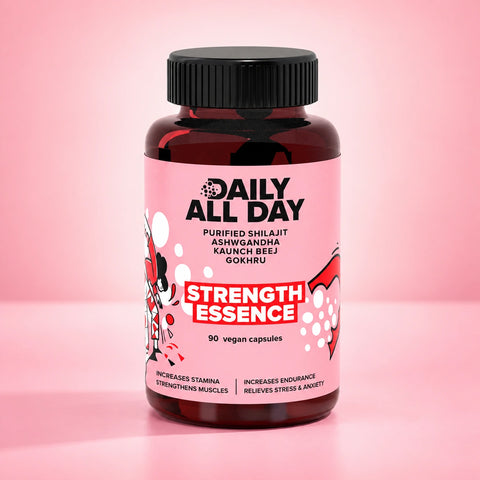
For stress-related sleep issues, explore our Strength Essence and Stress Free guide for how ashwagandha supports recovery and sleep under daily stress loads.
Daily All Day: FSSAI-Certified, Plant-Based, Designed for Indian Bodies
All products are vegetarian, lab-tested, FSSAI-compliant, GMP and HACCP certified. No artificial colors, no harmful additives. These are dietary supplements designed to support wellness as part of a balanced Indian lifestyle, not replacements for medical care.
If you are pregnant, nursing, post-surgery, or managing a chronic condition, please consult a registered doctor or qualified Ayurvedic practitioner before starting any supplement, including curcumin or ashwagandha-based products.
Frequently Asked Questions
Should I take curcumin with my Indian breakfast or with lunch , does timing actually matter?
Yes, timing matters more than most labels explain. Curcumin is fat-soluble, which means it absorbs poorly on an empty stomach or with a dry breakfast. Take it with your largest fat-containing meal of the day, typically a dal-tadka lunch or a meal with ghee or sabzi cooked in oil. Avoid taking it first thing in the morning with just tea. Consistency with meal-pairing over 60 to 90 days is what builds the anti-inflammatory effect relevant to curcumin for joint pain in perimenopause India.
I am on thyroid medication (levothyroxine). Can I take ashwagandha and curcumin together?
Ashwagandha may influence thyroid hormone levels in some individuals, as it has adaptogenic effects on the endocrine system. If you are taking levothyroxine or any thyroid medication, please check with your doctor before adding ashwagandha. Curcumin at typical supplement doses is generally considered safe alongside thyroid medication, but spacing it at least two hours from your thyroid pill is a practical precaution. Thyroid conditions are common in Indian women in the 40-50 age range, so this check is genuinely important, not just a disclaimer.
Is Daily All Day AYUSH approved or FSSAI approved , and does it matter which one?
It matters. Daily All Day products are FSSAI-licensed dietary supplements, not AYUSH-licensed medicines. FSSAI (Food Safety and Standards Authority of India) governs food products and nutraceuticals for safety and labelling. AYUSH licensing covers classical Ayurvedic formulations sold as medicines. A product does not need AYUSH approval to legally contain Ayurvedic herbs , it needs FSSAI compliance. Daily All Day products meet FSSAI standards and are manufactured in GMP and HACCP certified facilities. They support wellness but do not claim to treat, diagnose, or cure any condition.
Can I take these supplements during the monsoon , does humidity or season change anything?
Traditional Ayurvedic seasonal guidelines (ritucharya) note that digestive capacity (agni) is lower during the monsoon months (roughly July to September in India). This means your body may absorb fat-soluble supplements like curcumin and omega fatty acids slightly less efficiently on an empty stomach. The practical fix: take them mid-meal rather than at the start, and keep your monsoon meals warm and lightly spiced rather than cold or heavily fried. Also, monsoon weather tends to increase joint stiffness for many women because of barometric pressure changes , this is actually when consistent curcumin and omega support tends to feel most useful.
Who should NOT take curcumin or ashwagandha-based supplements?
Please consult a registered doctor or qualified Ayurvedic practitioner if you are: pregnant or breastfeeding; scheduled for surgery within two weeks (curcumin may affect blood clotting); on blood-thinning medications like warfarin; managing gallstones or bile duct conditions (curcumin stimulates bile production); on immunosuppressant therapy; or managing any chronic hormonal condition. Ashwagandha specifically should be avoided during pregnancy. These are not rare edge cases in India , thyroid disorders, diabetes management medications, and post-surgical recovery are common situations where checking first is genuinely necessary.
How long before I notice a real difference in joint stiffness?
Most studies on curcumin for joint pain in perimenopause India contexts and related populations show meaningful changes at 8 to 12 weeks of consistent daily use. Expect subtle improvement in morning stiff